Monday, 25 February 2013

The World of Animals
Imagine what would the world be if there were no animals in the jungles, no birds chirping in the morning, no honey bees making honey, no fishes in the ponds, no trees, flowers and fruits. Our surroundings would be empty. 
Animals play a very important role in our life. The surroundings in which they live and grow is called Environment. The animal kingdom is very large and has a variety of animals big and small which are found on land, in water and in air. They have different shapes and size. We study about these animals in the branch of Biology called Zoology. Since these animals are our natural resources, we should try our best to protect them and see that they are not killed. They need our love and care.    
Animals are very helpful to us  
  • Animals, which carry loads, are horses, elephants, camels and bullocks.   Bullock and camel carts are very popular in some parts of the country.
  • Farm animals like cows and buffalos give us milk. Camel milk is also used in some parts of the country.
  • We eat the meat of many animals like goat, chicken, pig, etc. 
  • Animals like dogs, cats and parrots may also be kept as pets in our homes. 
  • Do you know that the silken and woolen garments, which you wear, are also obtained from animals and not plants? Sheep and yaks give us wool while silk is obtained from a small insect called silkworm. 
  • Honeybees give us honey. 
  • Good manure is made from animal dung and dead animals.
  • Leather is also nothing but cured and processed animal skin. Ancient people used to cover their bodies using animal skins. Jackets, fur caps, coats and gloves, purses, etc. are all made from animal skin.                                                                                                                                                                                                                        
  • Classification of Animals Animals are unique in their looks and characteristics. Observe some animals in your locality. Do they have the same number of legs and a similar body structure? Compare your body parts with theirs. Each type is different from the other. A lion is very different from a cow and a dog does not have the same features as a cat. All living things have some common characteristics.
    How do we classify animals? They are classified on basis of the different types of characteristics they posses.
    1. Invertebrates
    Animals which don't have a backbone or skeleton, are called Invertebrates.
  • Microbes (small organisms, e.g. Amoeba)
  • Insects  Adult insects typically have three pairs of legs, one pair of antennae and in most instances, two pairs of wings.
2.   Vertebrates Animals which have a backbone or a bony skeleton, are called vertebrates.
  • Birds are members of a group of animals called vertebrates, which possess a spinal column or backbone; birds develop from embryos in eggs outside of the mother's body.
  • Fishes and all diverse group of animals that live and breathe in water. All fishes are vertebrates (animals with backbones) with gills for breathing. Most fishes have fins for swimming, scales for protection and a streamlined body for moving easily through the water. 
  • Reptiles are vertebrates that have a backbone with tough, dry skin covered with horny scales. Some of the most widespread living reptiles are turtles, lizards, snakes, crocodiles and alligators. 
  • Amphibians are animal with moist, hairless skin through which water can pass in and out, e.g. frog. They can live on land and in water.
  • Mammals have entirely different habits and behaviours. Humans are mammals. They give birth to their young directly, and don't lay eggs. According to the suitability of their environment, they have different organs for movement, feeding and breathing.                                                                                                                    
  •  Body Organs of Animals                                                                                                                                              a. Organs of Movement
    Animals can move in different ways from one place to another in search of food and shelter and have different types of body organs.
    Land Animals
    Land animals have four limbs.
  • Fore limbs--the two limbs in front are called fore limbs.
  • Hind limbs--the two at the back are known as hind limbs.
  • Some use all four limbs to walk, run or jump while some use only hind limbs, e.g. kangaroo.
  • Snakes, lizards, crocodile move by crawling, but they do have limbs. Snakes do not have legs.
Water Animals They have fins, webbed feet and paddle-like limbs.
  • Fins--fishes swim with the help of fins.
  • Webbed toes-- frogs swim with webbed toes, when on land they use hind legs to jump.
  • Paddle-like limbs--tortoise use four paddle-like limbs to push water.
  • Flippers--penguins use two fore limbs as flippers to push water forwards.

Birds (Animals of the air)
Birds have wings, which help in flying. The fore limbs (front) of birds are converted into wings, which have feathers.
Flightless birds--some birds are unable to fly because their wings are to weak for flying like for e.g. kiwi, ostrich, emu and rhea.
Insects
Some insects have one or two pairs of wings for flying e.g. butterfly. The wings are different from those of birds, as they have no feathers. They are made of tiny colored scales. Some have six legs for movement, e.g. cockroaches and ants. Grasshoppers use hind legs.

Why is movement important for animals?

  • To build resting places like nests etc.
  • To search for food
  • To protect themselves from enemies.

b.   Feeding Organs
Animals eat different types of food and have different types of feeding organs. They are classified on basis of the types of food they eat. 
  • Herbivores: Animals, which eat plants, are called herbivorous animals for e.g. cows, giraffes, goat etc. They have sharp front teeth for biting and strong broad teeth for chewing.
  • Carnivores: Animals who eat the flesh of other animals like lions, tiger, cat, vultures etc. They posses sharp pointed and curved teeth for tearing flesh.
  • Omnivores: They eat plants as well as flesh of other animals. E.g. crow kites and eagles. They have strong grinding teeth for chewing flesh and bones.
Animals eat and get their food in different ways.
  • Mosquitoes suck blood from the body of human beings.
  • Snakes swallow their food whole.  
  • Elephants have a long trunk. They lift their food with this trunk and put in into their mouths.  
  • Birds have beaks and claws.
  • Rabbits, rats, squirrel, etc. have sharp front teeth to gnaw seeds and fruits.
Why is food important? So that animals remain healthy, grow and get energy to survive and protect themselves from enemies.
 
c. Breathing Organs
  • Gills-- Fishes, tadpoles (baby frog), oysters, prawns and crabs breathe through gills. 
  • Lungs-- An adult frog breathes through its lungs on land. Birds, reptiles and mammals also breathe through lungs. 
  • Spiracles-- Insects have tiny air holes on their bodies called spiracles to breathe. 
  • Body surface-- Small microscopic animals breathe through their body surface like amoeba. 
Why is breathing important? Animals get oxygen while breathing, which burns the food within their bodies and they get energy to do work.

                                 JUSTICE FOR ANIMAL

Although animal law is “a niche market,” contentious issues such as raising animals for food and puppy mills that mass produce pets are making it grow, said Margit Livingston, an attorney who co-directs DePaul University's Center for Animal Law.
DePaul's law school houses the center that gives students the chance to study animal-welfare issues from a legal standpoint. The center, founded in 2002, focuses on education and research over advocacy. It also hosts an annual fall symposium on current issues, such as dog fighting and the treatment of circus animals.

In the conversation below, Livingston — who said she was interested in how the law deals with animals prior to joining the center — shared her thoughts on how animals are treated and how society views that treatment.

Q: What are the current biggest threats to animal welfare?
A: There are a number of issues at the forefront regarding animal welfare. There is continued concern about dog fighting and trying to get a handle on that. Puppy mills. The overbreeding of dogs and the less-than-desirable conditions that result for animals that are sick or have generally poor health. There’s a whole area of animals as food, the whole question of the conditions under which food animals are raised. That’s been on people’s minds lately.

Q: How do local animal welfare issues compare to the national ones?
A: There’s not really anything distinct from what’s going on in a lot of communities across the country. There is an effort by authorities to address those issues, but I don’t know if there are enough resources to put toward animal crimes. I would like to see the Illinois Department of Agriculture have a larger staff so that they could do more investigations and do them more thoroughly. They do the best they can with what they have, but they don’t have a lot of field agents anymore. They’re dealing with horses and cattle and even dogs and cats. It’s just a large territory they have to police.

Q:  What about Chicago’s feral cat problem?
A: That’s a controversial issue. Some people desire to do TNR [trap-neuter-return]. Some people think that large colonies of feral cats result in the destruction of wildlife; birds in particular are a target. You have people pretty much divided down the middle on that. [Debate over whether cats should] live their lives normally versus control of the population.

Q: Why do Americans seem to put animal welfare on the back burner?
A: I think a lot of people feel that we have a lot of pressing issues in society regarding poverty, health care and now employment issues, with the economy being somewhat weak, and that if we’re going to try to spread limited resources to address societal problems, those resources should go toward things that benefit humans. [For instance], why are we so concerned about how chickens are raised when we still haven’t solved our human problems? People don’t want to be confronted with, for one thing, how their food is raised. You see the steak in the grocery store, and you don’t realize where that came from. And I don’t think people want to think about that — it’s kind of unpleasant. It puts people in a quandary. Do I really want to consume something that is not humanely raised?

Q: How does animal treatment relate to larger scientific issues? For example, cattle factories that raise cattle for meat release lots of methane, contributing to climate change.
A: I think that animal welfare can spread into the environment. We’re living as part of an ecosystem, and we need to be aware of what we’re doing to the environment and whether there are unintended consequences in our consumption of resources and how that affects animals living in the wild. There’s certainly a very integrated connection between humans and animals.

Q: Can animals feel psychological pain in addition to physical pain?
A: That debate has been going on since the 18th century and the philosopher Jeremy Bentham [an animal rights supporter]. Obviously, they do feel pain, and they feel fear, and there’s no question that they have a certain level of consciousness and awareness that makes them subject to suffering.

Q: Why do you think this is such a divisive topic?
A: It is a very polarizing topic, and there are just so many odd ways in which we relate to animals. Hunting is legal, killing certain animals for food is legal, and yet we’re very sentimental about our dogs and cats. I don’t know if we as a society have thought through all of this stuff. We just accept things as a given.

Sunday, 24 February 2013


ANIMALS FEELINGS


In 350 B.C., Aristotle found evidence of emotion in animals. "Some are good-tempered, sluggish, and little prone to ferocity, as the ox; others are quick-tempered, ferocious, and unteachable, as the wild boar," he wrote in The History of Animals.

Today, the proposition that animals share some of the same feelings as man -- actually experiencing pain, grief, and joy -- is winning more advocates. And animal rights activists point to that concept as a concrete reason to end man's exploitation of animals. The reformers are getting help from biologist Marc Bekoff, of the University of Colorado, who has compiled a new book, The Smile of the Dolphin, (Discovery Books/Random House, $35) in which dozens of animal researchers explain why they believe animals have emotions.

The Grieving Chimp

In one chapter, primate expert Jane Goodall recounts the grief experienced by a chimpanzee child named Flint after his mother, Flo, died in Africa's Gombe National Park. "Over the next three weeks, Flint became increasingly lethargic. He stopped eating, and he avoided other chimps, huddling in the vegetation close to where he'd last seen Flo," she writes.

The sad-eyed mourner made his way to the spot where his mother had lain, next to a stream, staring into the water until he died.

"Chimpanzees, differing from us genetically by only just over one percent, can't be said to weep, for they don't shed tears. Yet--they show behavior that's associated with sadness, depression, and grief in humans: soft whimpering, crying sounds, listlessness, lack of appetite, avoidance of others," Goodall writes.

But are such animals truly "sad," in the sense that they realize something is lost that will never be regained? How can they be said to be happy, sad, or angry if they don't perceive themselves as a separate being?, the skeptics ask. Others say it's credible to count apes as capable of feeling, but a broad stretch to attribute emotions to lions or sheep.

"Does Flint reflect and say, 'I'm sad'? I don't know if he does, but he's behaving as if he's sad, and there's no reason to believe that he's not sad," Bekoff says, adding that anyone who lives with a dog knows when she's happy, sad, or fearful.

Human-Animal Bond

Clinton Sanders, a professor of sociology at the University of Connecticut, writes that he studied a guide-dog training program to find out more about the social bond between dogs and people.

"For people who depend on dogs for special assistance, knowing their animal companions' thought processes and feelings is central to building an effective alliance," Sanders says. "The visually-impaired people with whom I talked often spoke of the special pleasure their dogs derived from doing the work they were trained for -- and, in contrast, the embarrassment they obviously felt when they made mistakes."

Mother-Infant Bond

Jaak Panksepp, an expert in neuroscience at Bowling Green State University in Ohio, says he witnessed the power of the mother-infant bond when his two female cats, a mother and her daughter, each gave birth after building nests in closets on opposite ends of his long, ranch-style home.

The mother cat gave birth first, and the daughter, while awaiting her babies-- arrival, took charge of the mother's brood, carrying them to her nest. "Then we had a few days of chaos, as mother and daughter repeatedly ferried the kittens between their domains," Panksepp recounts. "We know many of the neurochemistries that activate these strong (maternal) feelings. At the basic emotional level, all mammals are remarkably similar."

So, what does it mean to believe that animals have feelings? "It means they are not just objects with which we can do what we please," Bekoff says. But the broader implications of viewing animals with more sensitivity could mean dramatic societal changes, like stopping the factory production of meat for humans, or granting animals more rights.

"I think it will have a subtle, slow impact," says Bekoff, who's a vegetarian. "I think the world is going to be different.


    TEN MOST ENDANGERED ANIMALS


1 Ivory-Billed Woodpecker

A North American bird so endangered it may actually be extinct

2 Amur Leopard

The world’s rarest cat: Only 40 left in Russia’s Far East

3 Javan Rhinoceros

No more than 60 of these swamp-dwelling Asian rhinos exist

4 Northern Sportive Lemur

Here’s the scarcest of Madagascar’s fast-dwindling lemur species

5 Northern Right Whale

Hunted to near extinction, 350 right whales still swim the Atlantic

6 Western Lowland Gorilla

Disease and illegal hunting are taking an alarming toll on this gentle giant of a primate

7 Leatherback Sea Turtle

The population of the world’s largest turtle is dropping at an alarming rate

8 Siberian (or Amur) Tiger

The world’s biggest cat weighs as much as 300 kilos (660 pounds)

9 Chinese Giant Salamander

Humans are eating the world’s largest amphibian into extinction

10 The Little Dodo Bird

Samoa’s little dodo bird is in immanent danger of following the large dodo into extinction.


         EXTINCT ANIMALS IN THE WORLD

Tasmanian Wolf is an extinct animal of marsupial. It is the first in the extinct animals list and it resembles with wolf and dog but it is neither a wolf nor a dog. It was extinct almost sixty five years ago when the Tasmanians started to make their land cultivable for human needs. Different animals preserving organizations are trying to find a pair of this unique type of carnivore to save its existence on the earth. The first mammal in the endangered animals top ten 10 list.
Halcan Fruit Bat lives mostly in the tropical parts of the world.  They are almost extinct and their presence is not seen in the recent times. Other forms of fruit eating bats except Halcon bats can be found on the earth. Mostly fruit bats show high mobility as they can travel for more than 30 miles in search of food.
Ghana Fat Mouse is a species of rodents family. As obvious from its name, it is the fatter mouse and mostly found in African countries. But the fat mouse family in Ghana is extinct now. Other species of this family can also be found in Sub-tropical regions of the world. This is the third animal family in the extinct animals list.
Javan Rhinoceros are one of the heaviest terrestrial animals on earth. Their habitat is Tropical and Subtropical moist broad leaf forests of South East Asia. Javan Rhinoceros are under deep threat of extinction and only 48 animals are left behind.  These heavy animals weigh around weighs 1500 – 2000 kg. Lifespan of these animals is about 35 to 40 years.
Iriomote Cat are the most rare species of cats family. They are found only on Iriomote island of Japan. Approximately, 60 cats are alive on this planet of earth. It has a deep resemblance with Leopard Cat and it is also a beautiful species of cat family. It has a small body.
Black Lion Tamarin are found only in Brazilian state of Sao Paulo. One of the most endangered mammal on earth, Lion Tamarin is also called the golden-rumped lion tamarin. Only 160 animal species are alive on the earth.
Pygmy Hog is the smallest pig of the world. Initially, it was found in different countries of Asia like Bhutan, India and Nepal. Now, they are almost extinct and only a few of them are found in India. Only 50 pygmy hogs are alive in India. The decline of their population is because of modification and elimination of its limited habitat by human settlement, agricultural encroachment etc.
Kouprey is the world’s rarest mammal. It is a forest ox weighing 680 – 910 kg. It inhabits low, rolling hills, covered by open country interrupted with patches of dry forest and adjacent to denser monsoon forest. They are found in eastern Asia like Laos, Vietnam and Thailand.
Tamaraw is a small wild buffalo and only 30 Tamaraws are alive in the world. They are mostly found on island of Mindoro (Philippines). They are strong powerful animals who can push through the dense forest and climb the steep mountains. The reason of tamaraw’s decline is hunting specially after Vietnam war.
Indus Dolphin is found mainly in Indus river of Pakistan. They live in deep waters of the river and feed mainly on several fishes and invertebrates. These marine animals are disappearing fast because of lowering of water level in river Indus. They are also famous as blind dolphins because there is no lens in its eye.


                                                      ELEPHANT

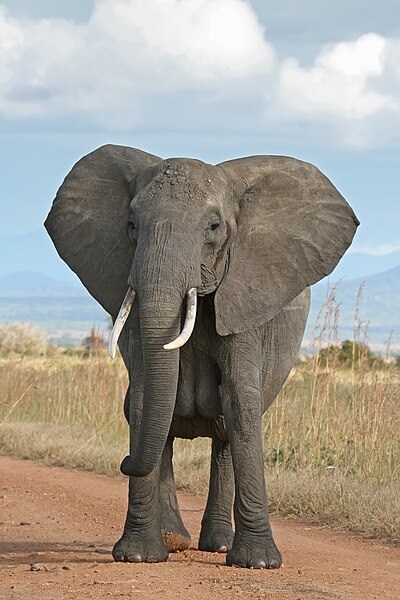
Elephants are large mammals of the family Elephantidae and the order Proboscidea. Traditionally, two species are recognised, the African elephant (Loxodonta africana) and the Asian elephant (Elephas maximus), although some evidence suggests that African bush elephants and African forest elephants are separate species (L. africana and L. cyclotis respectively). Elephants are scattered throughout sub-Saharan Africa, and South and Southeast Asia. They are the only surviving proboscideans; extinct species include mammoths and mastodons. The largest living terrestrial animals, male African elephants can reach a height of 4 m (13 ft) and weigh 7,000 kg (15,000 lb). These animals have several distinctive features, including a long proboscis or trunk used for many purposes, particularly for grasping objects. Their incisors grow into tusks, which serve as tools for moving objects and digging and as weapons for fighting. The elephant's large ear flaps help to control the temperature of its body. African elephants have larger ears and concave backs while Asian elephants have smaller ears and convex or level backs.
File:African Bush Elephant.jpg

                                 LION
The lion (Panthera leo) is one of the four big cats in the genus Panthera and a member of the family Felidae. With some males exceeding 250 kg (550 lb) in weight,[4] it is the second-largest living cat after the tiger. Wild lions currently exist in sub-Saharan Africa and in Asia (where an endangered remnant population resides in Gir Forest National Park in India) while other types of lions have disappeared from North Africa and Southwest Asia in historic times. Until the late Pleistocene, about 10,000 years ago, the lion was the most widespread large land mammal after humans. They were found in most of Africa, across Eurasia from western Europe to India, and in the Americas from the Yukon to Peru.[5] The lion is a vulnerable species, having seen a major population decline of 30–50% over the past two decades[date missing] in its African range.[2] Lion populations are untenable outside designated reserves and national parks. Although the cause of the decline is not fully understood, habitat loss and conflicts with humans are currently the greatest causes of concern. Within Africa, the West African lion population is particularly endangered.


                                   GIRAFFE
The giraffe (Giraffa camelopardalis) is an African even-toed ungulate mammal, the tallest living terrestrial animal and the largest ruminant. Its species name refers to its camel-like appearance and the patches of color on its fur. Its chief distinguishing characteristics are its extremely long neck and legs, its horn-like ossicones and its distinctive coat patterns. It stands 5–6 m (16–20 ft) tall and has an average weight of 1,600 kg (3,500 lb) for males and 830 kg (1,800 lb) for females. It is classified under the family Giraffidae, along with its closest extant relative, the okapi. The nine subspecies are distinguished by their coat patterns.
The giraffe's scattered range extends from Chad in the north to South Africa in the south, and from Niger in the west to Somalia in the east. Giraffes usually inhabit savannas, grasslands, and open woodlands. Their primary food source is acacia leaves, which they browse at heights most other herbivores cannot reach.

                                      PARROT

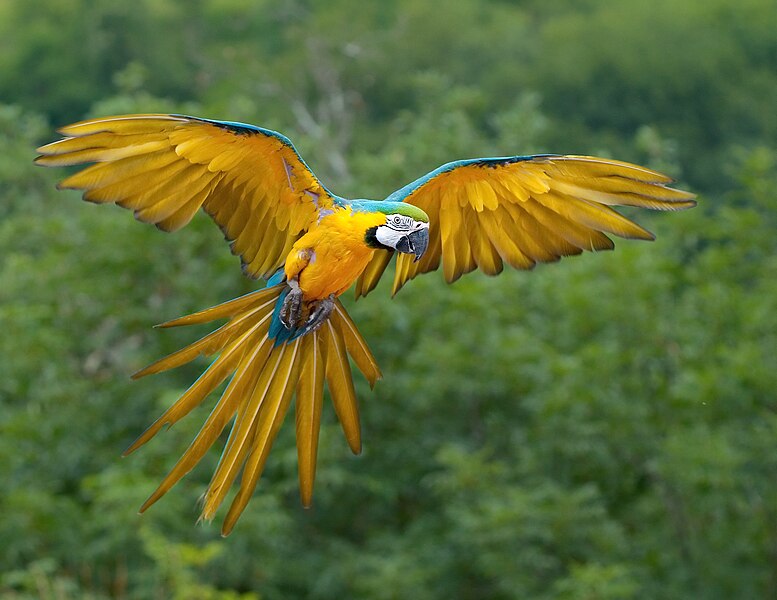
 Parrots, along with ravens, crows, jays and magpies, are among the most intelligent birds, and the ability of some species to imitate human voices enhances their popularity as pets. Trapping wild parrots for the pet trade, as well as hunting, habitat loss and competition from invasive species, has diminished wild populations, with parrots being subjected to more exploitation than any other group of birds. Measures taken to conserve the habitats of some high-profile charismatic species have also protected many of the less charismatic species living in the same ecosystems.
 The most important components of most parrots' diets are seeds, nuts, fruit, buds and other plant material. A few species sometimes eat animals and carrion, while the lories and lorikeets are specialised for feeding on floral nectar and soft fruits. Almost all parrots nest in tree hollows (or nest boxes in captivity), and lay white eggs from which hatch altricial (helpless) young.

File:Ara ararauna Luc Viatour.jpg

                                               DOLPHINS  
 Dolphins are marine mammals closely related to whales and porpoises. There are almost forty species of dolphin in 17 genera. They vary in size from 1.2 m (4 ft) and 40 kg (90 lb) (Maui's dolphin), up to 9.5 m (30 ft) and 10 tonnes (9.8 long tons; 11 short tons) (the orca or killer whale). They are found worldwide, mostly in the shallower seas of the continental shelves, and are carnivores, eating mostly fish and squid. The family Delphinidae is the largest in the Cetacean order, and evolved relatively recently, about ten million years ago, during the Miocene. Dolphins are among the most intelligent animals, and their often friendly appearance, an artifact of the "smile" of their mouthline, and seemingly playful attitude have made them very popular in human culture.   
File:Bottlenose Dolphin KSC04pd0178.jpg          
                                       EAGLE
 Eagle is a common name for some members of the bird family Accipitridae, and belong to several genera that are not necessarily closely related to each other. Most of the more than sixty species occur in Eurasia and Africa.[1] Outside this area, just eleven species can be found - two species (the Bald Eagle and Golden Eagle) in the United States and Canada, nine species in Central America and South America, and three species in Australia.


                                                 GORILLA
Gorillas comprise the eponymous genus Gorilla, the largest extant genus of primates by size. They are ground-dwelling, predominantly herbivorous apes that inhabit the forests of central Africa. The genus is divided into two species and either four or five subspecies. The DNA of gorillas is highly similar to that of a human, from 95–99% depending on what is counted, and they are the next closest living relatives to humans after the bonobo and common chimpanzee.
Gorillas' natural habitats cover tropical or subtropical forests in Africa.

                             HORSE
The horse (Equus ferus caballus) is one of two extant subspecies of Equus ferus, or the wild horse. It is an odd-toed ungulate mammal belonging to the taxonomic family Equidae. The horse has evolved over the past 45 to 55 million years from a small multi-toed creature into the large, single-toed animal of today. Humans began to domesticate horses around 4000 BC, and their domestication is believed to have been widespread by 3000 BC. Horses in the subspecies caballus are domesticated, although some domesticated populations live in the wild as feral horses. These feral populations are not true wild horses, as this term is used to describe horses that have never been domesticated, such as the endangered Przewalski's horse, a separate subspecies, and the only remaining true wild horse. There is an extensive, specialized vocabulary used to describe equine-related concepts, covering everything from anatomy to life stages, size, colors, markings, breeds, locomotion, and behavior.
                                DOG
The domestic dog (Canis lupus familiaris)[2][3] is a subspecies of the gray wolf (Canis lupus), a member of the Canidae family of the mammalian order Carnivora. The term "domestic dog" is generally used for both domesticated and feral varieties. The dog may have been the first animal to be domesticated, and has been the most widely kept working, hunting, and pet animal in human history. The word "dog" may also mean the male of a canine species,[4] as opposed to the word "bitch" for the female of the species.