ELEPHANT
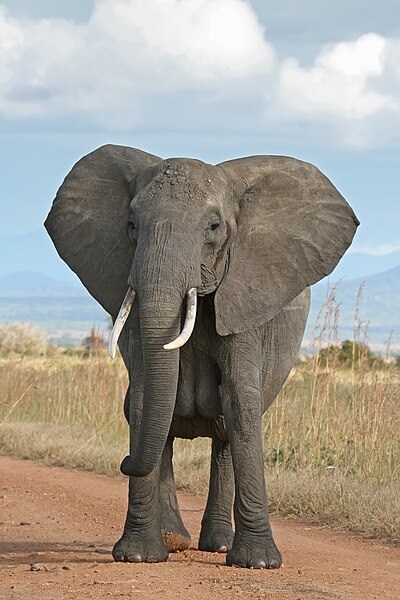
Elephants are large mammals of the family Elephantidae and the order Proboscidea. Traditionally, two species are recognised, the African elephant (Loxodonta africana) and the Asian elephant (Elephas maximus), although some evidence suggests that African bush elephants and African forest elephants are separate species (L. africana and L. cyclotis respectively). Elephants are scattered throughout sub-Saharan Africa, and South and Southeast Asia. They are the only surviving proboscideans; extinct species include mammoths and mastodons. The largest living terrestrial animals, male African elephants can reach a height of 4 m (13 ft) and weigh 7,000 kg (15,000 lb). These animals have several distinctive features, including a long proboscis or trunk used for many purposes, particularly for grasping objects. Their incisors grow into tusks, which serve as tools for moving objects and digging and as weapons for fighting. The elephant's large ear flaps help to control the temperature of its body. African elephants have larger ears and concave backs while Asian elephants have smaller ears and convex or level backs.
LION
The lion (Panthera leo) is one of the four big cats in the genus Panthera and a member of the family Felidae. With some males exceeding 250 kg (550 lb) in weight,[4] it is the second-largest living cat after the tiger. Wild lions currently exist in sub-Saharan Africa and in Asia (where an endangered remnant population resides in Gir Forest National Park in India) while other types of lions have disappeared from North Africa and Southwest Asia in historic times. Until the late Pleistocene, about 10,000 years ago, the lion was the most widespread large land mammal after humans. They were found in most of Africa, across Eurasia from western Europe to India, and in the Americas from the Yukon to Peru.[5] The lion is a vulnerable species, having seen a major population decline of 30–50% over the past two decades[date missing] in its African range.[2] Lion populations are untenable outside designated reserves and national parks. Although the cause of the decline is not fully understood, habitat loss and conflicts with humans are currently the greatest causes of concern. Within Africa, the West African lion population is particularly endangered.

GIRAFFE
The giraffe (Giraffa camelopardalis) is an African even-toed ungulate mammal, the tallest living terrestrial animal and the largest ruminant. Its species name refers to its camel-like appearance and the patches of color on its fur. Its chief distinguishing characteristics are its extremely long neck and legs, its horn-like ossicones and its distinctive coat patterns. It stands 5–6 m (16–20 ft) tall and has an average weight of 1,600 kg (3,500 lb) for males and 830 kg (1,800 lb) for females. It is classified under the family Giraffidae, along with its closest extant relative, the okapi. The nine subspecies are distinguished by their coat patterns.
The giraffe's scattered range extends from Chad in the north to South Africa in the south, and from Niger in the west to Somalia in the east. Giraffes usually inhabit savannas, grasslands, and open woodlands. Their primary food source is acacia leaves, which they browse at heights most other herbivores cannot reach.

PARROT
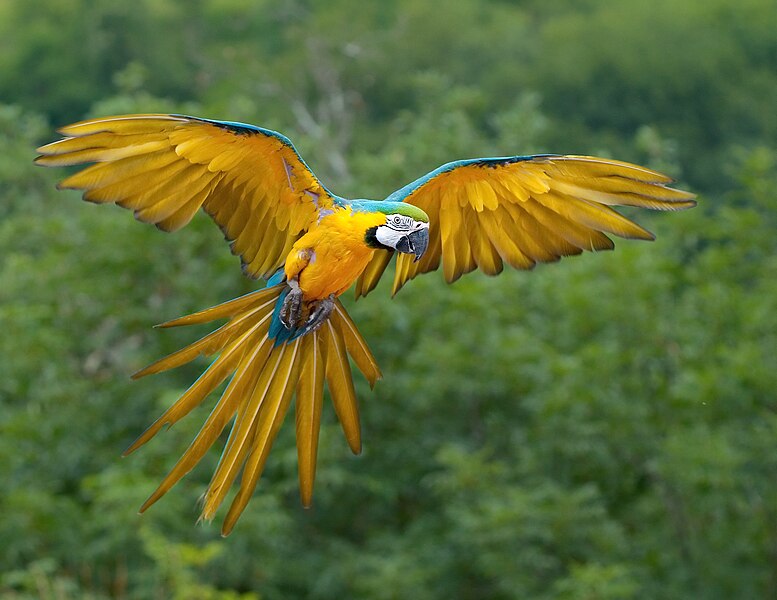
Parrots, along with ravens, crows, jays and magpies, are among the most intelligent birds, and the ability of some species to imitate human voices enhances their popularity as pets. Trapping wild parrots for the pet trade, as well as hunting, habitat loss and competition from invasive species, has diminished wild populations, with parrots being subjected to more exploitation than any other group of birds. Measures taken to conserve the habitats of some high-profile charismatic species have also protected many of the less charismatic species living in the same ecosystems.
The most important components of most parrots' diets are seeds, nuts, fruit, buds and other plant material. A few species sometimes eat animals and carrion, while the lories and lorikeets are specialised for feeding on floral nectar and soft fruits. Almost all parrots nest in tree hollows (or nest boxes in captivity), and lay white eggs from which hatch altricial (helpless) young.
DOLPHINS
Dolphins are marine mammals closely related to whales and porpoises. There are almost forty species of dolphin in 17 genera. They vary in size from 1.2 m (4 ft) and 40 kg (90 lb) (Maui's dolphin), up to 9.5 m (30 ft) and 10 tonnes (9.8 long tons; 11 short tons) (the orca or killer whale). They are found worldwide, mostly in the shallower seas of the continental shelves, and are carnivores, eating mostly fish and squid. The family Delphinidae is the largest in the Cetacean order, and evolved relatively recently, about ten million years ago, during the Miocene. Dolphins are among the most intelligent animals, and their often friendly appearance, an artifact of the "smile" of their mouthline, and seemingly playful attitude have made them very popular in human culture.

Eagle is a common name for some members of the bird family Accipitridae, and belong to several genera that are not necessarily closely related to each other. Most of the more than sixty species occur in Eurasia and Africa.[1] Outside this area, just eleven species can be found - two species (the Bald Eagle and Golden Eagle) in the United States and Canada, nine species in Central America and South America, and three species in Australia.

GORILLA
Gorillas comprise the eponymous genus Gorilla, the largest extant genus of primates by size. They are ground-dwelling, predominantly herbivorous apes that inhabit the forests of central Africa. The genus is divided into two species and either four or five subspecies. The DNA of gorillas is highly similar to that of a human, from 95–99% depending on what is counted, and they are the next closest living relatives to humans after the bonobo and common chimpanzee.
Gorillas' natural habitats cover tropical or subtropical forests in Africa.

HORSE
 The horse (Equus ferus caballus) is one of two extant subspecies of Equus ferus, or the wild horse. It is an odd-toed ungulate mammal belonging to the taxonomic family Equidae. The horse has evolved over the past 45 to 55 million years from a small multi-toed creature into the large, single-toed animal of today. Humans began to domesticate horses around 4000 BC, and their domestication is believed to have been widespread by 3000 BC. Horses in the subspecies caballus are domesticated, although some domesticated populations live in the wild as feral horses. These feral populations are not true wild horses, as this term is used to describe horses that have never been domesticated, such as the endangered Przewalski's horse, a separate subspecies, and the only remaining true wild horse. There is an extensive, specialized vocabulary used to describe equine-related concepts, covering everything from anatomy to life stages, size, colors, markings, breeds, locomotion, and behavior.
DOG
The domestic dog (Canis lupus familiaris)[2][3] is a subspecies of the gray wolf (Canis lupus), a member of the Canidae family of the mammalian order Carnivora. The term "domestic dog" is generally used for both domesticated and feral varieties. The dog may have been the first animal to be domesticated, and has been the most widely kept working, hunting, and pet animal in human history. The word "dog" may also mean the male of a canine species,[4] as opposed to the word "bitch" for the female of the species.


No comments:
Post a Comment